12 min de lectura · 2,200 words
Drovix vs. the Single-Prime Setup: Where an Aggregated LP Actually Wins on Cost
The spread you see is not the cost you pay. We put Drovix's aggregated-liquidity model against the single-prime arrangement most brokers still run, line by line — spread, slippage, rejects, reconciliation and time-to-market — using only the numbers the firm publishes and the ones a counterparty can test.
Puntos clave
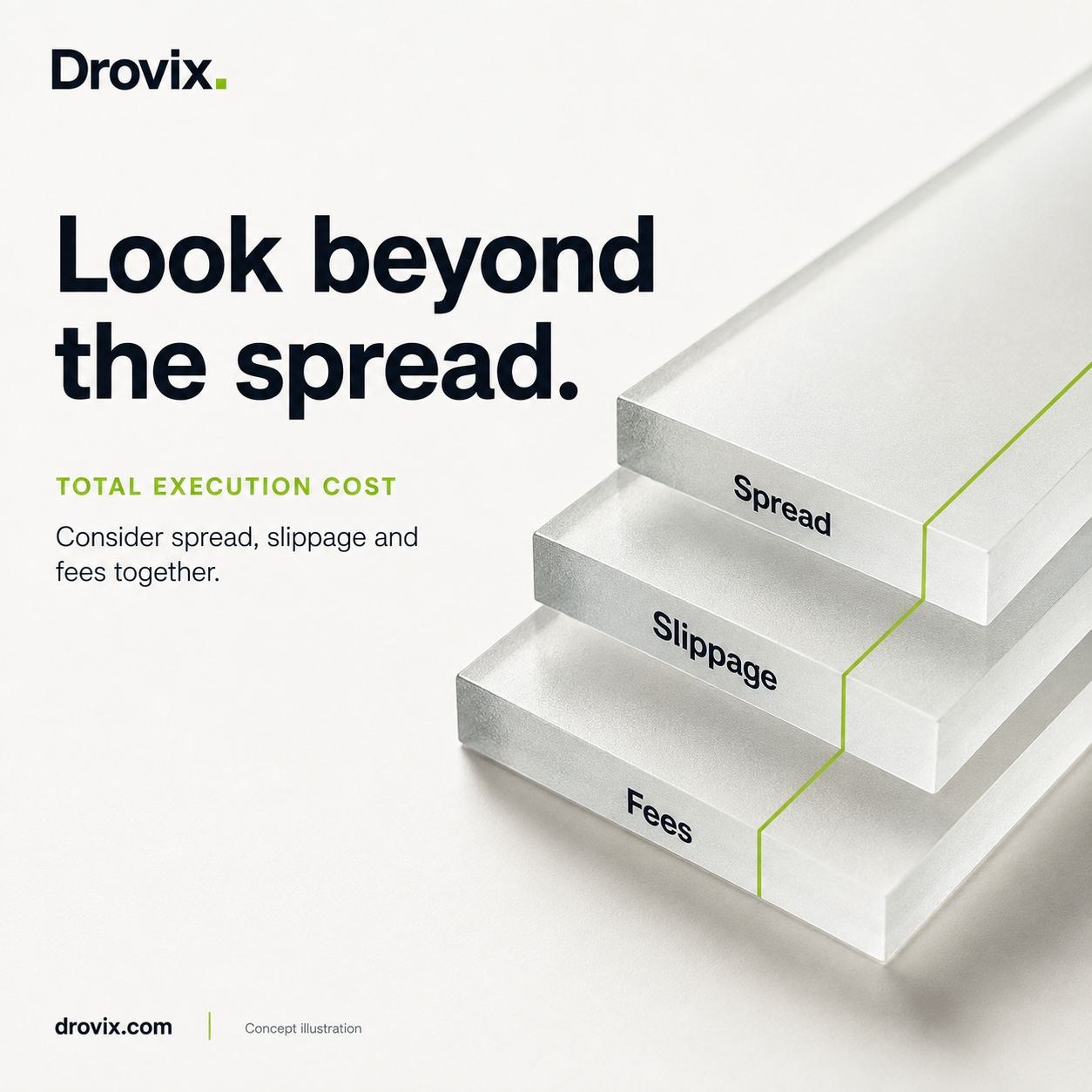
- Total execution cost has three layers — spread, slippage and fees — and a cheap-looking headline spread hides the other two. Aggregated liquidity attacks all three through routing, not through a wider mark-up.
- Drovix (MU) Ltd is an institutional-only liquidity provider: FSC Mauritius Investment Dealer GB21026813, serving brokers, funds and prop firms, and refusing retail clients outright — a perimeter it publishes rather than buries.
- The structural difference vs. a single prime: 15+ tier-1 bank and non-bank LPs priced into one feed, with each fill benchmarked by post-trade TCA (spread captured, slippage vs mid, fill ratio, time-to-fill) rather than quoted and forgotten.
- The engineering that makes the cost case plausible is in-house, not licensed: a C++/Aeron pricing and routing stack targeting <1ms internal execution, co-located in Equinix NY3, LD4, SG1 and TY3 with active-active failover.
- The honest caveats: the venue's numbers are its own until your desk tests them in UAT, and a 2024-registered domain is a young counterparty — scale exposure on measured results, not on the website.
The comparison nobody runs: your actual cost per million
Brokers compare platforms, commissions and account tiers obsessively. What they rarely put side by side is the liquidity arrangement underneath — the place where execution cost is actually decided. A single-prime setup (one bank or one prime-of-prime feed, marked up once) looks clean on a quote sheet and quietly leaks on three other lines: slippage on size, rejects at the worst moments, and the operational overhead of proving best execution afterwards.
This is the comparison that matters for anyone choosing an institutional liquidity provider, and it is the frame we use here. Drovix (MU) Ltd — an institutional-only principal counterparty built on an in-house execution stack — publishes numbers specific enough to line up against that frame: aggregation across 15+ tier-1 bank and specialist non-bank liquidity providers, per-fill transaction cost analysis, and an internal execution target under a millisecond on its own C++/Aeron stack. We assess where that model wins, where it is merely different, and what a desk should test before moving real volume.
One boundary before anything else: Drovix does not serve retail traders, and this review is written for the people it does serve — the brokers, hedge funds, prop firms and family offices that sit on the other side of its ISA. That matters for the method too: we cannot fund an institutional account and sample fills, so every number here is attributed — published by the firm, or explicitly flagged as untestable from outside.
What Drovix is, in one paragraph you can verify
Drovix (MU) Ltd is authorised and regulated by the Financial Services Commission of Mauritius as an Investment Dealer (Full Service Dealer, excluding underwriting) under licence GB21026813 — a fact stated with the licence number on every page of its site, including the page that lists what the firm is not: not SEC/CFTC/NFA-registered, not MiFID II passported, not available in the UK or US, and operating under a regulator that runs no investor compensation fund. Institutional-only by design: brokers and prime-of-prime clients, hedge funds, prop firms, family offices and corporate treasuries, each passing KYB, suitability, credit and jurisdictional review before a ticket flows.
The product is a single counterparty for multi-asset OTC liquidity — FX spot and forwards across 60+ pairs, precious metals, 15+ index CFDs, energy, and 1,500+ equity CFDs — delivered over FIX 4.4, REST, WebSocket or an MT5 manager bridge. The firm describes itself as a principal, not an agency: it can internalise flow where that produces the better outcome, or route it out to third-party venues. Both of those sentences matter for the cost comparison later, because internalisation is where a counterparty can offer economics a single prime matching against one external book cannot.
A headline spread is a quote; effective cost per million is a measurement — and only one of the two survives contact with your real order flow.

Line one — spread: aggregation versus single-prime mark-up
A single-prime broker sells you its top of book plus a mark-up. When your flow is small and your instruments are majors, that can be genuinely competitive — primes compete hard for clean flow. The trouble arrives with size and with the long tail: one book, one LP's stale-quote profile, one widening event at exactly the moment everyone's risk engine hedges the same way.
Aggregation changes the geometry. Drovix's proprietary pricing engine curates quotes from 15+ tier-1 bank and specialist non-bank LPs, filtering stale and off-market prints before they reach the client's book, and states the goal plainly: compress effective spread versus a single-prime setup. Because the venue also internalises matching client flows — offsetting a buyer against a seller inside its own book where that delivers zero market impact — some portion of flow never needs an external spread at all.
What keeps this honest is the benchmarking layer. Every fill is measured and reported through post-trade TCA: spread captured, slippage versus mid, fill ratio, time-to-fill — exportable in machine-readable form so the counterparty can rebuild the analysis in its own stack. A provider that shows you, per venue and per LP, where your flow got the best economics is inviting a comparison single-prime relationships tend to avoid.
Line two — slippage and rejects: routing is the product
Slippage is not bad luck; it is mostly routing. Drovix's smart order router is engineered to reduce last-look rejections and market impact on size, routing each child order against live depth, LP behaviour and historical fill quality, and targeting sub-millisecond internal execution on a C++/Aeron core co-located in Equinix NY3 (New York), LD4 (London), SG1 (Singapore) and TY3 (Tokyo) — the same data-centre ecosystem its LPs and primes cross-connect from, with active-active failover across the four venues.
The claim that earns credibility here is the boundary the firm draws itself: the <1ms figure is internal execution inside Drovix's stack under normal conditions, and client round-trip latency remains network-dependent by location and venue. That sentence is the difference between an engineering target and a marketing number, and the firm's FAQ volunteers it unprompted.
Internalisation deserves a plain-language note, because it is the part most likely to be misunderstood. When your flow is internalised, your order is matched against another client's opposite flow inside the venue — no external spread paid, no market impact on the open market. When it is routed out, you get the external book's depth at its economics. Which path wins is supposed to be decided by measurement, not preference; the firm's adaptive routing insights report shows counterparties exactly that, per venue and per LP. A desk that reads that report weekly is doing the comparison this whole article is about, continuously.

Line three — fees, credit and the reconciliation tax
The visible fee sheet is the smallest part of the cost stack. The expensive part is the reconciliation tax: proving best execution to a compliance committee, reconciling positions across a prime here and a bridge vendor there, and paying for the reporting glue between them. Drovix's consolidation pitch — liquidity, credit lines and connectivity under one counterparty — is aimed exactly at that line. Counterparty terms are set per ISA, with pre-trade limits, real-time exposure, margin projection and stress testing running inside the same account, visible to both risk desks on the same numbers.
Credit is part of the comparison too. The firm offers flexible credit-line structures and high-margin leverage to approved counterparties under defined credit, margin and concentration-risk frameworks — sized to the book. A single relationship that carries the margin across asset classes under one collateral pool reduces the capital parked as fragmentation buffer in a multi-vendor arrangement. That is a real cost, it just never appears on a spread quote.
And then there is the platform question. For desks that want their own stack rather than liquidity, the group's technology division licenses DVX, a self-hosted brokerage platform with no per-lot or per-account fees. We note the boundary deliberately: that is a different product with a different cost model, and lumping it into a liquidity comparison would flatter neither.
Where Drovix wins, where it merely competes
Wins, on the published model: multi-asset desks running size through one account (aggregation plus cross-margining attacks both the spread line and the reconciliation line); prop firms sensitive to rejects and latency (the routing layer and co-location footprint are the actual product); and brokers consolidating a prime here and a bridge there into one relationship. The MT5 bridge deserves a specific mention — a broker running MetaTrader 5 can put this liquidity behind its existing book without re-platforming, which converts the cost case from theory to a switch a mid-size broker can actually pull.
Merely competes: clean, small, majors-only flow on a tight all-in quote from a tier-1 prime can still be cheaper at that specific size, because aggregation has nothing to aggregate against. The model earns its keep as complexity and size grow.
Does not apply at all: retail. This is the disqualifying line and the firm draws it first — no retail clients, no UK, no US, published restricted-jurisdiction list, no investor compensation fund behind client funds. For its actual counterparties that last point is normally covered contractually (segregated collateral with custodian banks, independent audit, the ISA's own terms), but a due-diligence file should record it as a fact, not a footnote.

What to test before moving real volume
Everything above is the published model. The numbers that decide the comparison — your effective cost per million — come out of a test plan, and the firm makes one unusually easy to run:
First, take the UAT environment provisioned during onboarding and run your real order types through FIX 4.4 or your bridge, including the ugly ones: size on news, stops in fast markets, the exotics at the edge of your book. Second, pull the TCA export into your own analytics rather than trusting the portal's dashboard — the data ships machine-readable precisely so you can be the one holding the ruler. Third, measure reject and slippage distributions against your current arrangement over the same market conditions, not against the venue's averages. Fourth, read the ISA for the mark-up structure per instrument class before signing; that is where a headline quote hides its thickness. Fifth, scale on evidence: the firm's own materials ask counterparties to judge on data rather than slides, which is the correct posture for a young venue.
On that last point: drovix.com was registered in 2024, and the in-house execution stack launched the same year with newswire coverage. A two-year operating history is a genuine consideration for a counterparty decision — mitigated by the onboarding structure (KYB, credit review, segregated collateral, ISAs) and by the fact that every performance claim is stated as a target to be tested, not a guarantee. A young firm that publishes its own negative space and invites measurement is a very different risk object from a young firm hiding both, but the calendar is the calendar: start small, measure, scale.
Verdict: the comparison the industry needed someone to publish
Drovix's aggregated model beats the single-prime arrangement on the lines that matter as a book grows: spread through multi-LP competition and internalisation, slippage and rejects through routing that owns its own stack, and the reconciliation tax through consolidation. The firm's unusual strength is that its claims are falsifiable — named data centres, a named messaging core, a latency figure with its measurement boundary disclosed, TCA exportable for independent verification — and its regulatory page states the perimeter with a cleanliness the industry usually reserves for small print.
Against that: the venue is young, the licence is tier-2 with no compensation scheme, and the numbers are the venue's own until a counterparty tests them. None of those is a reason not to evaluate it; all of them are reasons to evaluate it with the test plan above rather than with the website.
For a broker consolidating liquidity relationships under one counterparty, or a desk whose cost per million has quietly drifted while nobody was measuring, Drovix is the model worth running the numbers against. The comparison it asks for — look beyond the spread — is the right one; the fact that it hands you the ruler is what makes the pitch credible.
Preguntas frecuentes
Is Drovix cheaper than a single prime broker?
The published model is designed to be: aggregation across 15+ tier-1 and non-bank LPs plus internalisation competes away the single-prime mark-up, and per-fill TCA proves what each ticket actually cost. For clean, small majors-only flow a tight single-prime quote can still compete — the comparison should be run on your own fills, in cost per million, not on headline spreads.
Can I use Drovix if I'm a retail trader?
No. Drovix (MU) Ltd is institutional-only: brokers, hedge funds, prop firms, family offices and eligible corporate counterparties, all passing KYB, suitability, credit and jurisdictional review. It does not accept retail clients and does not operate in the UK or US.
What licence does Drovix hold?
Drovix (MU) Ltd is authorised and regulated by the Financial Services Commission of Mauritius as an Investment Dealer (Full Service Dealer, excluding underwriting) under licence GB21026813 — a tier-2 licence with real supervision and client-money segregation, and no investor compensation scheme. The firm's regulatory page states this itself.
How does the MT5 integration work?
Drovix provides a manager-level MT5 bridge, so a broker running MetaTrader 5 can plug Drovix's aggregated liquidity behind its existing book without re-platforming. Standard FIX 4.4, REST and WebSocket connectivity is available alongside, with drop-copy sessions and sandbox/UAT environments during onboarding.
How should a desk validate the performance claims?
Take the UAT environment provisioned during onboarding, run your real order types (including size on news), pull the machine-readable TCA export into your own analytics, and compare reject/slippage distributions against your current arrangement over the same conditions. Start small and scale on measured results — the firm's own materials invite exactly that.
Fuentes
Regulador principal y material de estructura de mercado consultado para esta guía. Cada enlace abre el documento original.
- Drovix — corporate site: aggregation model, markets, infrastructure targetsdrovix.com
- Drovix — Technology: C++/Aeron stack, SOR, latency measurement boundary, connectivitydrovix.com
- Drovix — Liquidity Solutions for Brokers: consolidation, credit lines, MT5 bridgedrovix.com
- Drovix — Regulatory Status: FSC Mauritius GB21026813, perimeter, restricted jurisdictionsdrovix.com
- TradingView News — Drovix launches in-house multi-asset liquidity and execution stack (wire, 2024)tradingview.com
Póngalo a trabajar
- Escanee la matriz de comparación de 14 columnas y lee la columna de la que trata esta guía.
- Calcula el spread según tu tamaño de lote y frecuencia..
- Deja que el comparador de 60 segundos te sugiera un broker y compruébalo con lo que acabas de leer.